



AnswersHow does it all connect?
Health & Safety Policy: What Inconsistent Application Looks Like?
When the same café chain gives a different answer each time about heating a cinnamon roll, it shows a health and safety policy that hasn't been communicated across sites. In higher-risk settings like construction, that inconsistency risks injury and legal claims. A policy only works when everyone it covers knows it, understands it and applies it the same way everywhere.
- 1In order to ensure a policy is applied consistently Communication is critical across all levels.
- 2We're using a high-street coffee shop as an example But this scenario can easily apply to Construction, Manufacturing, Ports & Maritime, and more.
- 3A health & safety policy nobody knows about Undermines the good intention behind creating it to begin with.
Health & safety matters: it’s your day off, so you get up early to make the most of it, and the first stop is going to be your favourite high-street café. You already know what you’ll be ordering – your usual brew. While you’re there, you may as well treat yourself to a cinnamon roll, heated up. When the order’s handed to you, you head off with both in hand to enjoy the rest of your morning.
The following weekend, you place the same order at the same café in the same location. This time, you get a different reaction, and the barista apologises because they no longer heat up cinnamon rolls, for health & safety reasons. You’re not too happy, but you understand and you take yours cold.
Two weeks later, you’re in a branch of the same café chain on the other side of town. You love a warm cinnamon roll, so you chance your luck. No problem at all, they say, and it comes back warm, flaky, and oozing chocolate. Belly full of delicious coffee and fresh pastry, you’re happy – but a part of you is a little confused. Is this a store health & safety policy or not? Why did they flag it once and then not the next time? Maybe they changed their mind about the policy?
01When a Policy Is Applied Inconsistently
What we’re looking at here is an inconsistent application of a health & safety policy. On the surface, it might only seem like a bit of an inconvenience for the customer (which can be a problem in itself), but the main concern here is that there has obviously been a breakdown in communicating this particular health & safety directive across multiple stores, and that can lead to a number of other issues.
Firstly, in this example there is a clear risk being posed to the customer and the business. If this health & safety policy is needed to be rolled out chain-wide, then customers need to be protected against this risk, and employees need to enforce it consistently. Secondly, since we’ve established that this is a genuine risk, the café needs to insulate itself against any legal cases that could be brought against it. That could come about in light of a customer suffering an injury owing to the policy not being adhered to by staff.
02How Does This Look Elsewhere?
Think about this in the content of other industries. Imagine a new health & safety policy has been rolled out that restricts the transport of a certain hazardous material through a live construction site during times when the site is densely populated (daytime hours, for example). In this scenario, it could be argued that the stakes are higher because the material is hazardous and could potentially harm dozens of people if the policy isn’t adhered to properly. Regardless of the industry or the risk exposure, it’s important to recognise that a new health & safety policy requires a great deal of planning to get it right, on multiple levels.
For starters, a designated person or a group of people first need to understand the ins and outs of this policy, they then need to contextualise that for a larger group, and the information has to be communicated across all levels of leadership, throughout all employee crews, and to subcontractors. Plus, since it’s a new policy, it has to be added to documentation, signposted on site, and so on. There’s a lot of work in making sure it is communicated efficiently.
03Deciding on a Policy Isn’t Enough on its Own
At times, it might seem enough to make a decision on one site and trust that somebody will spread the word to the rest. Sometimes it works by sheer luck, but it’s not a good approach. Often the message arrives late, arrives half-remembered, or doesn’t arrive at all, and that can have repercussions.
Planning, rolling out, and communicating a policy are equally as important as spotting the risk and coming up with the policy. As we know at FlexManager, a health & safety policy only works when everyone it applies to knows about it, understands it, and follows it the same way, in every location where it’s applicable. Otherwise, it’s just a good intention, not a good implementation of a health & safety policy.
 Short · 0:33Flex Insights - Incident ReportingIncident Reporting
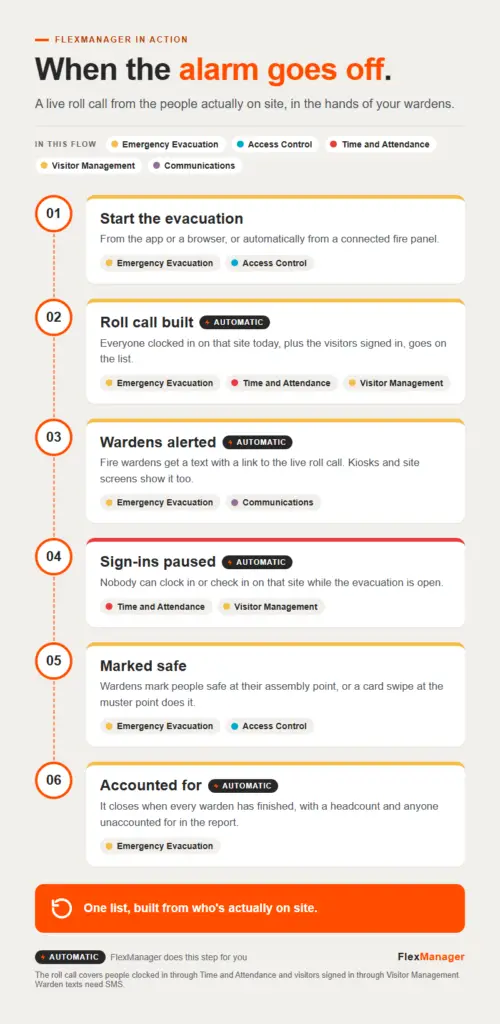 InfographicWhen the alarm goes offAccess Control · Communications · Emergency Evacuation · Time and Attendance · Visitor Management
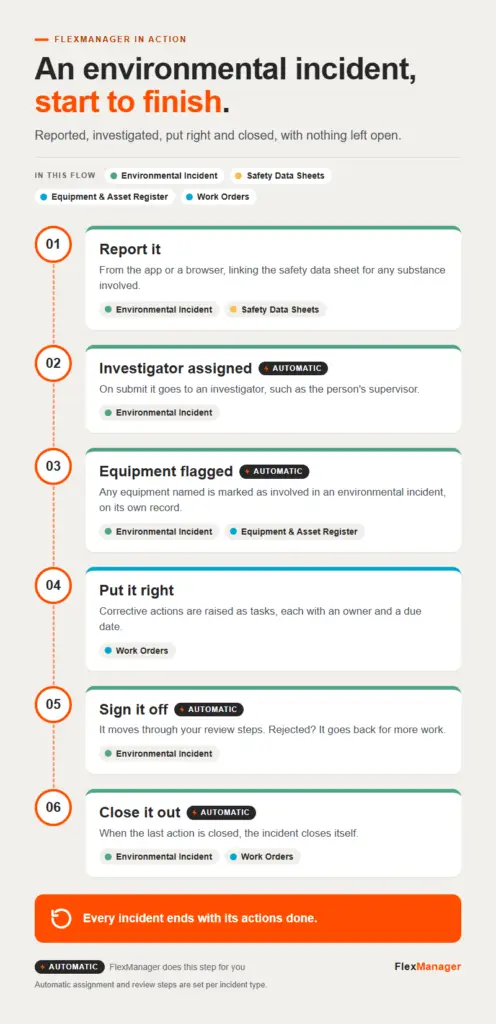 InfographicAn environmental incident, start to finishEnvironmental Incident · Equipment & Asset Register · Safety Data Sheets · Work Orders