Health Surveillance Compliance: HSE’s Landmark Warning to Employers
HSE issued its first Prohibition Notice against an occupational health provider. See what it means for health surveillance compliance and contractor management.
Fire crews responded to a significant industrial fire at a woodworking facility in Toronto’s west end on Wednesday morning.
The incident occurred on Primrose Avenue, near Lansdowne Avenue and Dupont Street, according to a CP24 report citing Toronto Fire officials.
Authorities reported that the fire broke out at a site believed to be used for woodworking. When emergency responders arrived, they encountered heavy smoke and visible flames coming from the building. Firefighters remained on the scene and continued to actively battle the blaze throughout the morning.
No injuries have been reported, and officials confirmed that no one was inside the facility at the time the fire started. The cause of the fire has not yet been determined, and an investigation is expected to follow.
Toronto Fire told CP24 that the situation was under control, but crews would remain on site to ensure the fire was fully extinguished and to monitor for any potential flare-ups. The incident did not result in any reported injuries to workers or emergency personnel.
Officials have not released further details about the extent of the damage or the potential impact on nearby businesses and residents. Updates are expected as the investigation continues.
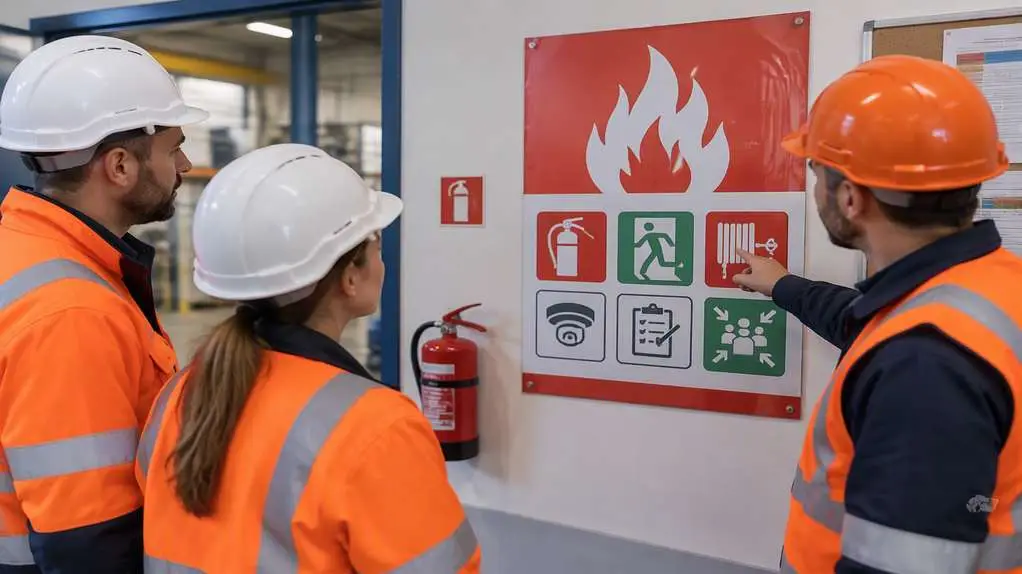
How can employers promote fire safety?
Employers can be better prepared to respond in case of fire if they have fire safety plans.
According to the Canadian Centre for Occupational Health and Safety (CCOHS), these plans are often required by your local Fire Code, especially for certain buildings and occupancy rates.
“Plans should be specific to the property or business. Conducting an audit or review of the property or business will help identify factors that could affect fire safety.”
“Items in this audit include site layout, points of entry/exit, roadways, use of the building, where and how items are stored, how items are used, water or fire department connections, alarm systems, sprinkler systems, and many other factors.”

The government agency notes that while specific requirements may vary by jurisdiction, in general, a fire safety plan should include:
Original Article – The Safety Mag
HSE issued its first Prohibition Notice against an occupational health provider. See what it means for health surveillance compliance and contractor management.
For many organisations, managing HSEQ compliance has traditionally meant juggling spreadsheets, paper records, and disconnected systems. The result? Time-consuming processes, limited visibility, and a higher risk of errors or missed obligations.
Germany's TÜV Building Report 2026 found 35.9% of technical building systems have major defects, including fire suppression and ventilation. Here is what it means for facilities managers everywhere.
For organisations operating across multiple sites or with contractor teams, managing access isn’t just about security, it’s about safety, compliance, and operational efficiency. Every individual entering a site or performing tasks should be authorised, trained, and verified.
The HSA and HSENI have launched a joint all-island silica dust inspection campaign for construction sites running June to August 2026. Here is what employers need to do to stay compliant.
Esso was fined £1 million after corrosion identified in 2010 caused a catastrophic gas leak in 2022. The Fawley verdict is a warning for every organisation managing ageing industrial assets.
France has launched its National Occupational Health Plan 2026–2030, raising the bar on workplace safety compliance, risk assessments, and contractor worker training. Here is what it means for employers.
Whether it’s improving data accuracy, streamlining training, or equipping teams with durable technology, FlexManager has you covered with reliable products that provide assurance in compliance for organisations. We are looking back at our "Product Showcases" to explore once more how our centralised solution can work with technology to transform day-to-day operations for our clients. Let's revisit each product featured, what it offers, and why it matters.
Ontario's JHSC certification training programme changes from 1 July 2026. Find out what is new and how FlexManager helps Ontario employers stay compliant and inspection-ready.
For many organisations, especially those operating across multiple sites or working with contractors, controlling and verifying access can quickly become complex. Manual sign-in processes, paper records, or disconnected systems often make it difficult to confirm whether individuals are properly trained, authorised, or compliant before they enter a site or carry out critical work.
Germany's ArbSchG reforms from June 2026 formally integrate mental health into workplace risk assessments. Learn what has changed and how FlexManager helps organisations stay compliant.
Canada's 2026 Work Fatality Report recorded 1,042 deaths in 2024 and rising rates in seven jurisdictions. Learn why traditional safety approaches are no longer enough and what proactive compliance looks like.
Fill out the form below and one of our FlexPerts will contact you.