
Ireland and Northern Ireland Silica Dust Campaign 2026: Compliance Action Required for Construction Employers
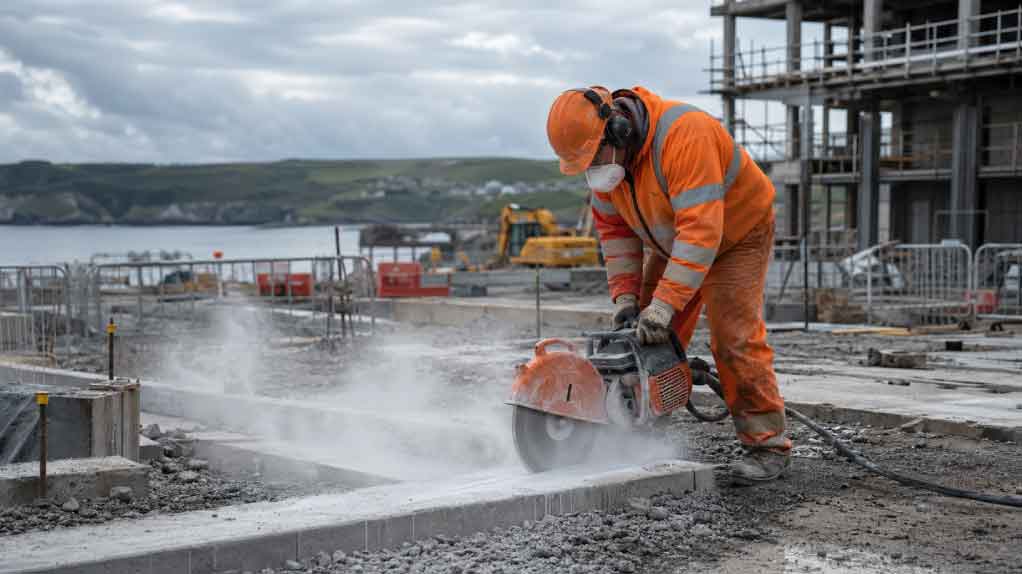
It cannot be seen. It cannot be smelled. And it can take years to cause the damage that ultimately kills. Respirable crystalline silica dust is one of the most significant occupational health hazards in the construction industry, and it is generated every time a worker cuts, grinds, drills, or demolishes materials containing concrete, stone, brick, or sand-based compounds.
From 1 June 2026, the Health and Safety Authority in Ireland and the Health and Safety Executive for Northern Ireland launched a joint, coordinated inspection campaign targeting silica dust exposure across the island of Ireland. The three-month campaign, running through to 31 August 2026, will see inspectors from both regulators visiting construction sites simultaneously, assessing whether employers have the controls in place to protect their workers from a disease that is both preventable and incurable.
For construction employers operating on either side of the border, this is an active enforcement campaign, not an awareness initiative. Inspectors will be on site, and where controls are found to be inadequate, enforcement action will follow.
Â
Why Silica Dust Demands Serious Attention
Silicosis is a progressive, irreversible lung disease caused by inhaling fine silica dust particles that damage and scar lung tissue over time. Symptoms include persistent coughing, shortness of breath, fatigue, and increasing respiratory infections. In its most advanced form, the body can no longer take in enough oxygen to sustain vital organs. There is no cure.
The scale of the problem in Northern Ireland alone is stark: HSENI figures indicate that an estimated 20 people die each year in Northern Ireland from lung cancer attributable to silica dust exposure in the workplace. Across the island, and across Europe, the construction sector accounts for a disproportionate share of occupational lung disease cases precisely because silica-generating activities, including cutting, grinding, drilling, and demolition, are routine parts of everyday site work.
The materials that carry the risk are everywhere on a typical construction site: concrete blocks, natural stone cladding, brick, floor screeds, render, and paving. The activities that release the dust are standard: angle grinders, disc cutters, jackhammers, core drills, and demolition by hand. When these activities are carried out without the right controls, workers are exposed to concentrations of silica particles that accumulate in the lungs over a working career, with consequences that become apparent only years or decades later.
Â
What Inspectors Will Be Checking
During the campaign, HSA and HSENI inspectors will focus specifically on high-risk construction activities that are known to generate hazardous levels of silica dust. The assessment will go beyond asking whether a worker is wearing a mask. Inspectors will look for a structured, documented approach to silica risk management across the full hierarchy of controls.
The hierarchy begins with elimination: can the activity be redesigned to avoid generating dust at all? Where elimination is not possible, substitution comes next: can a lower-risk material or method be used? Engineering controls are the third tier: on-tool extraction, wet cutting, enclosed cabins, local exhaust ventilation. Only when these measures are in place and verified as effective should respiratory protective equipment be relied upon as an additional layer of protection.
Inspectors will also look at health monitoring. For workers regularly exposed to silica dust, ongoing health surveillance is not optional. It is a legal requirement. Employers must be able to demonstrate that workers in high-exposure roles are receiving appropriate periodic health checks, that records are being maintained, and that the results are being used to verify that controls are working. Where a worker begins to show early signs of dust-related disease, the health surveillance system should detect this before it becomes irreversible.
Training records will also be under scrutiny. Workers carrying out cutting, grinding, drilling, or demolition activities must have received documented training on the risks of silica dust, the controls required, and the correct use of any RPE provided. The fact that a worker has been on site for many years is not a substitute for a formal, recorded training event.
Â
The Hidden Compliance Gap in Construction
The practical challenge for many construction employers is not that they are unaware of silica dust as a hazard. Most site managers know the risk. The gap is in the management system that converts that awareness into consistent, documented, verifiable compliance across an entire workforce, on multiple sites, with contractors and subcontractors who arrive and leave throughout the project lifecycle.
Health surveillance records for subcontracted workers are frequently incomplete or held in paper formats that are not accessible to the principal contractor when an inspection occurs. Training records for individual operatives may exist in different systems, or may not have transferred when a worker moved between employers. Control measures may be in place for directly employed staff but not consistently applied to contractors working alongside them.
For a principal contractor, the legal exposure does not end with their own directly employed workforce. Where contractors work under their control and direction, the employer has a duty to ensure those workers are also protected. This is the point at which informal systems break down.
Â
How FlexManager Helps Construction Employers Demonstrate Compliance
For construction employers who want to be ready for an HSA or HSENI inspection, the answer is a structured, digital approach to health and safety management that covers the full workforce, directly employed and contracted, on every site.
FlexManager supports construction employers across every dimension of silica dust compliance. Health and safety management enables employers to build and maintain documented COSHH-equivalent risk assessments for silica-generating activities, specifying the controls required, the RPE standard, and the health surveillance obligations for each role or task type. These assessments are accessible on site and updated in real time when working methods or materials change.
Workforce training and competency management gives employers a live record of every operative’s training history, including silica dust awareness, RPE fit testing, and safe working method training. Expiry dates are tracked automatically, and the system flags when a worker’s training is due for renewal before it lapses. This applies equally to directly employed workers and to subcontractors.
Contractor management ensures that subcontractors arriving on site have been inducted, that their relevant certifications and health surveillance records have been reviewed, and that they are formally on record before work begins. No contractor starts without the right documentation confirmed.
Audit and inspection management provides structured digital checklists for site compliance inspections, including dust control checks, RPE condition reviews, and health surveillance verification. When a gap is found, a corrective action is automatically generated and tracked.
Occupational health monitoring enables employers to schedule and record health surveillance activities for workers in high-exposure roles, with alerts when checks are due or overdue. The system maintains a complete health surveillance record that is accessible, auditable, and defensible.
Are you ready for an inspector to walk onto your site today? If any part of that answer is uncertain, the time to address it is before the inspector arrives, not after. See how FlexManager supports construction employers in building a compliance system that stands up to scrutiny: Book a demo today!
Original Article: All-Ireland safety campaign targets silica dust
Sun and Heat Safety Compliance: What Ireland’s Heatwave Means Now
Ireland's 2026 heatwave puts sun and heat safety compliance in focus. See how FlexManager keeps UV risk assessments and toolbox talks on record.
OSHA Contractor Safety Compliance: Lessons from Two Texas Cases
Two Texas OSHA cases expose contractor safety compliance gaps in confined space and staffing. See how FlexManager manages contractor pre-qualification.
What Good Looks Like: On-site Audits & Inspections
What Good Looks Like: On-site Audits & Inspections On-site audits and inspections are a core part of HSEQ and compliance. But when they are not managed well, they quickly become a source of stress. Missed checks, inconsistent records, and unclear follow-ups can lead to more than just admin headaches. They create real risks around safety,…
Electrical Equipment Inspection Compliance: Germany’s New Rules
Germany moves toward risk-based electrical equipment inspection compliance. See how FlexManager tracks asset inspections and keeps you audit-ready.
Module Spotlight – Incident Reporting
Peter Mullins, Director of Business Development at FlexManager, gives an overview of our Incident Reporting module, covering how incidents can be created and categorised by type, each with its own bespoke review workflow, and how the module connects directly into Asset Management and Training records.
Asset Management with FlexManager: Scan, Identify, Know Everything Instantly
Struggling with missing assets or unknown locations? FlexManager's Asset Management module uses NFC technology to give every asset a digital identity, so your team can scan, identify, and know everything instantly. As part of our Plant & Equipment core solution, this module offers organisations control and oversight of their stock, in an efficient, real-time platform that is designed to fit your process.Â
Safety Representative Compliance: Finnish Manufacturing Trend
Finnish manufacturing sees safety representative compliance rise 10 percent. Learn how FlexManager keeps consultation and safety records audit-ready.
Warehouse Racking Inspection Compliance: WorkSafeBC Fine Lessons
A $75K WorkSafeBC fine shows why warehouse racking inspection compliance needs real audit trails, not just paperwork. See how FlexManager helps.
The Hidden Cost of Poor Safety Management
Safety management is often seen as a regulatory necessity. Something that keeps organisations compliant and avoids penalties. But in reality, poor safety management goes far beyond compliance issues. It creates hidden costs that impact productivity, performance, and people.
Excavation Safety Compliance: What a $330,000 OHS Penalty Teaches Contractors
A $330,000 Alberta OHS penalty highlights excavation safety compliance gaps. See how FlexManager helps contractors manage trench safety and training records.
Contractor Safety Management: Why Site Coordination Cannot Be an Afterthought
A recent French industrial site incident highlights contractor safety management gaps. See how FlexManager helps coordinate contractors, permits and site risk.
What Good Looks Like: Asset Management with FlexManager
Asset management often runs in the background, until something fails. A missed inspection leads to a safety risk. Equipment breaks down unexpectedly. An audit reveals gaps in maintenance records. What should be a controlled process quickly becomes a problem for operations, safety, and compliance.