Ireland’s Health and Safety Authority is not waiting for incidents to happen this summer. On 5 June 2026, the HSA launched a nationwide inspection campaign targeting major outdoor events, including concerts and festivals, with inspectors actively visiting sites to assess safety standards and drive improvements in occupational health and safety compliance.
This is the seventh inspection campaign undertaken by the HSA this year, and it reflects a clear pattern: the Authority is maintaining a sustained, sector-by-sector enforcement posture throughout 2026, following the sharp rise in workplace fatalities recorded in 2025.
Why Outdoor Events and Why Now
At first glance, the events industry might seem like an unusual focus for an occupational safety regulator. But the risks involved in large-scale outdoor event operations are real, significant, and often poorly managed.
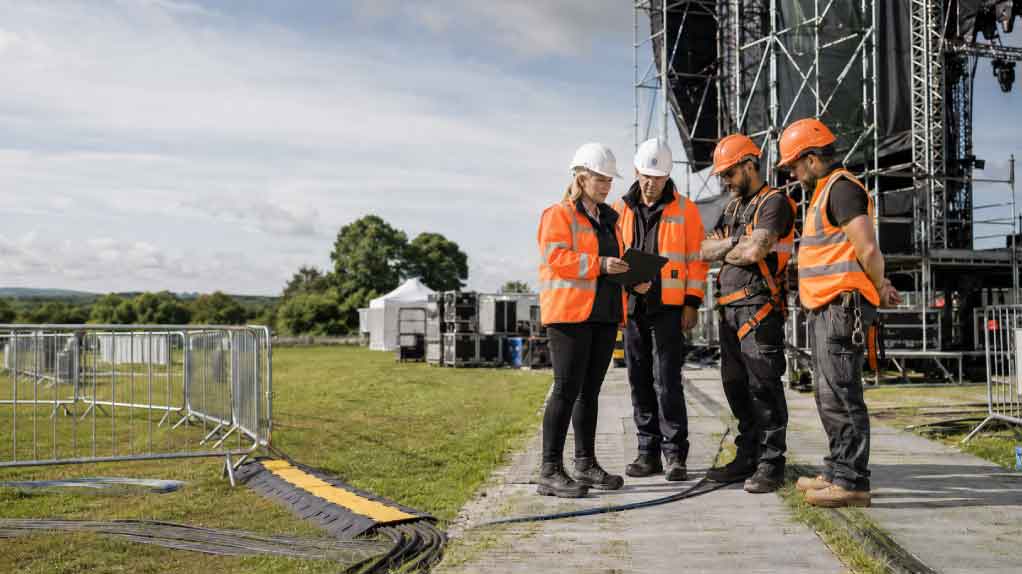
The events industry employs large numbers of contractors and outdoor workers, particularly during the build-up and dismantling phases. These load-in and load-out activities can involve significant risks, carried out under time pressure in fast-moving working environments and often in poor weather conditions. A further complicating factor is that much of the work can take place adjacent to event attendees and members of the public, increasing the need for robust planning, supervision and risk management.
Particular attention will be paid to work at height, vehicle movements, electrical safety, and contractor supervision during the set-up and dismantling phases of events. The HSA has been direct about the consequences of non-compliance. Where unsafe work activities are identified, enforcement action will follow.
The Contractor Supervision Challenge
The complexity that defines large outdoor event operations is not unique to the events sector. It is present in construction, facilities management, utilities, and any environment where multiple contractors work simultaneously across a shared site. And it exposes one of the most persistent gaps in occupational safety management: contractor supervision.
When work is delivered by a rotating roster of subcontractors, each with their own methods, training levels, and safety cultures, the responsibility for ensuring consistent compliance falls squarely on the event organiser or principal contractor. That means having clear sight of who is on site, what tasks they are performing, what equipment they are using, whether they have been inducted, whether their risk assessments are in place, and whether the controls they are supposed to be following are actually being followed.
In practice, many organisations manage this through a combination of paper-based inductions, verbal briefings, and informal supervision. Under the pressure of a live event build, with dozens of contractors working across a temporary site and a hard deadline for doors to open, that approach breaks down quickly.
The HSA’s focus on contractor supervision is a signal that this is where compliance most commonly fails, and where the consequences are most serious.
From Informal to Structured: What Good Contractor Management Looks Like
The good news is that the fundamentals of good contractor safety management are well understood. They require clarity on who has been inducted, documented evidence that risk assessments have been communicated, clear records of equipment checks and work at height controls, and real-time visibility of who is on site at any given moment.
These are not complex requirements. But they do require a structured approach that survives the heat of a fast-moving operational environment. That means moving away from clipboards and informal handovers, and toward digital systems that capture compliance evidence in real time, even when the site is busy, the weather is poor, and the clock is ticking.
Platforms like FlexManager are built for exactly this kind of environment. FlexManager helps organisations manage contractor inductions, track permits to work, document risk assessments, log equipment inspections, and maintain a real-time record of site activity across multi-contractor operations. When an HSA inspector arrives, the compliance evidence is there, structured, accessible, and credible.
Are your contractor supervision records inspection-ready this summer? If your contractor inductions, risk assessments, work at height records, and equipment checks are not structured, documented, and easy to produce under pressure, now is the time to fix that. FlexManager gives Irish employers a practical, digital platform to manage contractor compliance from the first induction to the final sign-off: Book a demo today!