
Ireland and Northern Ireland Silica Dust Campaign 2026: Compliance Action Required for Construction Employers
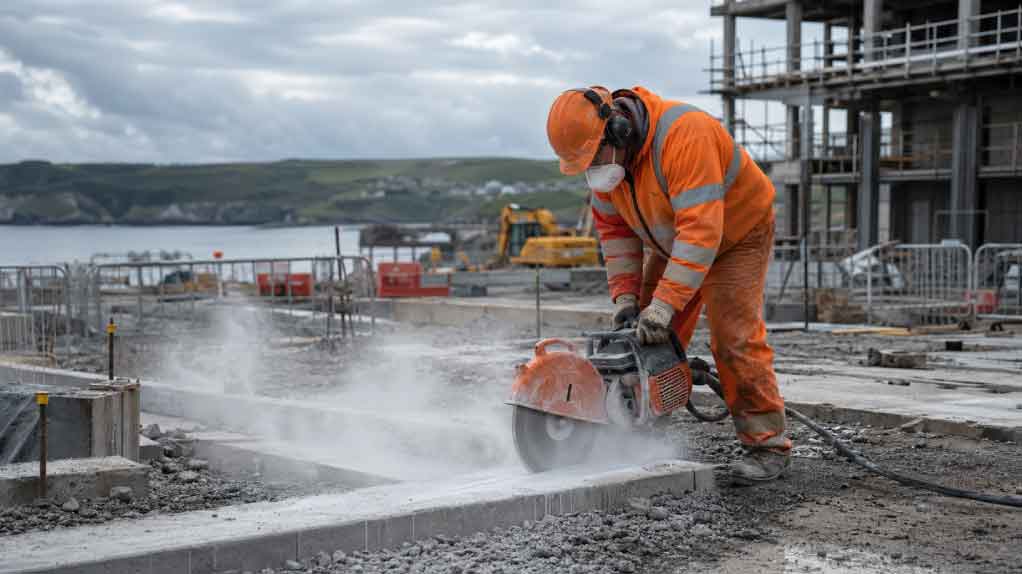
It cannot be seen. It cannot be smelled. And it can take years to cause the damage that ultimately kills. Respirable crystalline silica dust is one of the most significant occupational health hazards in the construction industry, and it is generated every time a worker cuts, grinds, drills, or demolishes materials containing concrete, stone, brick, or sand-based compounds.
From 1 June 2026, the Health and Safety Authority in Ireland and the Health and Safety Executive for Northern Ireland launched a joint, coordinated inspection campaign targeting silica dust exposure across the island of Ireland. The three-month campaign, running through to 31 August 2026, will see inspectors from both regulators visiting construction sites simultaneously, assessing whether employers have the controls in place to protect their workers from a disease that is both preventable and incurable.
For construction employers operating on either side of the border, this is an active enforcement campaign, not an awareness initiative. Inspectors will be on site, and where controls are found to be inadequate, enforcement action will follow.
Â
Why Silica Dust Demands Serious Attention
Silicosis is a progressive, irreversible lung disease caused by inhaling fine silica dust particles that damage and scar lung tissue over time. Symptoms include persistent coughing, shortness of breath, fatigue, and increasing respiratory infections. In its most advanced form, the body can no longer take in enough oxygen to sustain vital organs. There is no cure.
The scale of the problem in Northern Ireland alone is stark: HSENI figures indicate that an estimated 20 people die each year in Northern Ireland from lung cancer attributable to silica dust exposure in the workplace. Across the island, and across Europe, the construction sector accounts for a disproportionate share of occupational lung disease cases precisely because silica-generating activities, including cutting, grinding, drilling, and demolition, are routine parts of everyday site work.
The materials that carry the risk are everywhere on a typical construction site: concrete blocks, natural stone cladding, brick, floor screeds, render, and paving. The activities that release the dust are standard: angle grinders, disc cutters, jackhammers, core drills, and demolition by hand. When these activities are carried out without the right controls, workers are exposed to concentrations of silica particles that accumulate in the lungs over a working career, with consequences that become apparent only years or decades later.
Â
What Inspectors Will Be Checking
During the campaign, HSA and HSENI inspectors will focus specifically on high-risk construction activities that are known to generate hazardous levels of silica dust. The assessment will go beyond asking whether a worker is wearing a mask. Inspectors will look for a structured, documented approach to silica risk management across the full hierarchy of controls.
The hierarchy begins with elimination: can the activity be redesigned to avoid generating dust at all? Where elimination is not possible, substitution comes next: can a lower-risk material or method be used? Engineering controls are the third tier: on-tool extraction, wet cutting, enclosed cabins, local exhaust ventilation. Only when these measures are in place and verified as effective should respiratory protective equipment be relied upon as an additional layer of protection.
Inspectors will also look at health monitoring. For workers regularly exposed to silica dust, ongoing health surveillance is not optional. It is a legal requirement. Employers must be able to demonstrate that workers in high-exposure roles are receiving appropriate periodic health checks, that records are being maintained, and that the results are being used to verify that controls are working. Where a worker begins to show early signs of dust-related disease, the health surveillance system should detect this before it becomes irreversible.
Training records will also be under scrutiny. Workers carrying out cutting, grinding, drilling, or demolition activities must have received documented training on the risks of silica dust, the controls required, and the correct use of any RPE provided. The fact that a worker has been on site for many years is not a substitute for a formal, recorded training event.
Â
The Hidden Compliance Gap in Construction
The practical challenge for many construction employers is not that they are unaware of silica dust as a hazard. Most site managers know the risk. The gap is in the management system that converts that awareness into consistent, documented, verifiable compliance across an entire workforce, on multiple sites, with contractors and subcontractors who arrive and leave throughout the project lifecycle.
Health surveillance records for subcontracted workers are frequently incomplete or held in paper formats that are not accessible to the principal contractor when an inspection occurs. Training records for individual operatives may exist in different systems, or may not have transferred when a worker moved between employers. Control measures may be in place for directly employed staff but not consistently applied to contractors working alongside them.
For a principal contractor, the legal exposure does not end with their own directly employed workforce. Where contractors work under their control and direction, the employer has a duty to ensure those workers are also protected. This is the point at which informal systems break down.
Â
How FlexManager Helps Construction Employers Demonstrate Compliance
For construction employers who want to be ready for an HSA or HSENI inspection, the answer is a structured, digital approach to health and safety management that covers the full workforce, directly employed and contracted, on every site.
FlexManager supports construction employers across every dimension of silica dust compliance. Health and safety management enables employers to build and maintain documented COSHH-equivalent risk assessments for silica-generating activities, specifying the controls required, the RPE standard, and the health surveillance obligations for each role or task type. These assessments are accessible on site and updated in real time when working methods or materials change.
Workforce training and competency management gives employers a live record of every operative’s training history, including silica dust awareness, RPE fit testing, and safe working method training. Expiry dates are tracked automatically, and the system flags when a worker’s training is due for renewal before it lapses. This applies equally to directly employed workers and to subcontractors.
Contractor management ensures that subcontractors arriving on site have been inducted, that their relevant certifications and health surveillance records have been reviewed, and that they are formally on record before work begins. No contractor starts without the right documentation confirmed.
Audit and inspection management provides structured digital checklists for site compliance inspections, including dust control checks, RPE condition reviews, and health surveillance verification. When a gap is found, a corrective action is automatically generated and tracked.
Occupational health monitoring enables employers to schedule and record health surveillance activities for workers in high-exposure roles, with alerts when checks are due or overdue. The system maintains a complete health surveillance record that is accessible, auditable, and defensible.
Are you ready for an inspector to walk onto your site today? If any part of that answer is uncertain, the time to address it is before the inspector arrives, not after. See how FlexManager supports construction employers in building a compliance system that stands up to scrutiny: Book a demo today!
Original Article: All-Ireland safety campaign targets silica dust
TÜV Building Report 2026: 35.9% Defect Rate Is a Warning for Facilities and Asset Managers
Esso was fined £1 million after corrosion identified in 2010 caused a catastrophic gas leak in 2022. The Fawley verdict is a warning for every organisation managing ageing industrial assets.
Access Control: Beyond the Basics
For organisations operating across multiple sites or with contractor teams, managing access isn’t just about security, it’s about safety, compliance, and operational efficiency. Every individual entering a site or performing tasks should be authorised, trained, and verified.
Ireland and Northern Ireland Silica Dust Campaign 2026: Compliance Action Required for Construction Employers
The HSA and HSENI have launched a joint all-island silica dust inspection campaign for construction sites running June to August 2026. Here is what employers need to do to stay compliant.
Esso £1M Fine: Why Asset Integrity and Inspection Management Cannot Wait
Esso was fined £1 million after corrosion identified in 2010 caused a catastrophic gas leak in 2022. The Fawley verdict is a warning for every organisation managing ageing industrial assets.
France PST 2026–2030: What Employers Need to Know About Workplace Safety Compliance
France has launched its National Occupational Health Plan 2026–2030, raising the bar on workplace safety compliance, risk assessments, and contractor worker training. Here is what it means for employers.
Equipment for Safer, Smarter HSEQ Management: Our Product Showcases
Whether it’s improving data accuracy, streamlining training, or equipping teams with durable technology, FlexManager has you covered with reliable products that provide assurance in compliance for organisations. We are looking back at our "Product Showcases" to explore once more how our centralised solution can work with technology to transform day-to-day operations for our clients. Let's revisit each product featured, what it offers, and why it matters.
Ontario’s JHSC Training Is Changing on 1 July 2026. Here Is What Employers Need to Know
Ontario's JHSC certification training programme changes from 1 July 2026. Find out what is new and how FlexManager helps Ontario employers stay compliant and inspection-ready.
Access Control: The Fundamentals
For many organisations, especially those operating across multiple sites or working with contractors, controlling and verifying access can quickly become complex. Manual sign-in processes, paper records, or disconnected systems often make it difficult to confirm whether individuals are properly trained, authorised, or compliant before they enter a site or carry out critical work.
Germany’s 2026 Workplace Safety Reforms: Is Your Risk Assessment Compliant?
Germany's ArbSchG reforms from June 2026 formally integrate mental health into workplace risk assessments. Learn what has changed and how FlexManager helps organisations stay compliant.
UK Compliance Failures Cost Millions: Three Cases Every Safety Manager Should Know
Canada's 2026 Work Fatality Report recorded 1,042 deaths in 2024 and rising rates in seven jurisdictions. Learn why traditional safety approaches are no longer enough and what proactive compliance looks like.
Rethinking the Health & Safety Audit Checklist
Rethinking the H&S Audit Checklist Health & safety audits have never been more importan, but the way many organisations build and use their audit checklists hasn’t kept pace with the reality of modern operations. Too often, checklists are inherited, generic, overloaded, or disconnected from the risks teams actually face day to day. Let’s break down…
We’re Hiring! Become a Flexpert Today
We’re expanding our team and we couldn’t be more excited to welcome applications to the following roles: Customer Operations Manager, Marketing Creative Assistant, Software Tester, and Android Developer.