
So claims don’t start as a blank form.
An insurance claim that starts from scratch, disconnected from the incident that caused it, means re-entering the same details and losing track of costs. FlexManager's Insurance Claims module syncs directly from an incident report, tracks costs and appointments through the process, and keeps every stakeholder informed to resolution.
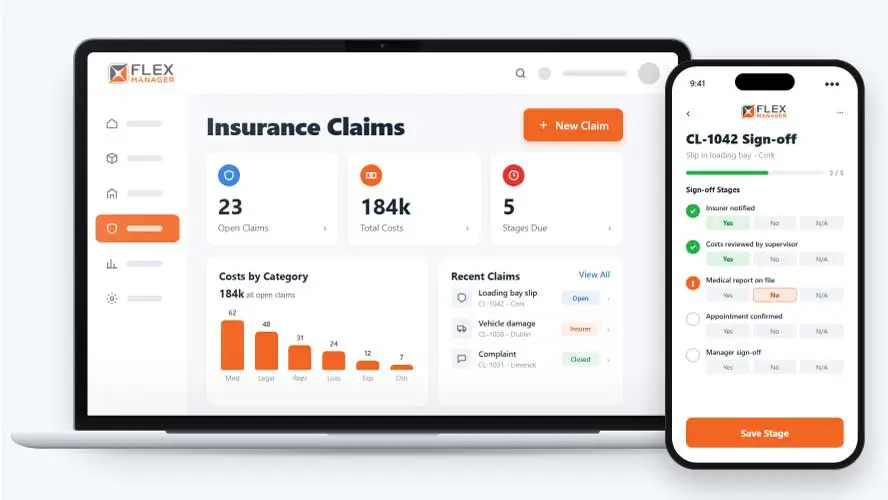









Insurance claims often start from a blank form, even though the incident and employee details are already recorded. Retyping wastes time, adds errors and leaves no clear thread from incident to resolution.
Typed in twice
Dates, names and costs are copied again from the incident report, with room for mistakes.
Files everywhere
Photos, statements and insurer letters sit in inboxes and shared drives instead of with the claim.
Closed without sign-off
Claims are closed when someone remembers, and nobody can show who agreed.
From incident to closed claim
One claim file follows the case from the first report to the last approval.
Raise
Raise the claim from an incident, without typing it again.
Details
The incident's actual costs, photos, and supporting documents come across into the claim.
Sign off
Finish the claim and it moves through the review stages for sign-off.
Close and report
The last approval closes it out.
Key features & benefits
Incident-to-Claim Sync
A claim can be synced directly from the incident report that caused it, saving on the duplicated effort of re-entering the same details into a separate claim record.
Cost Tracking Through the Claim Process
Monitor the financial impact of an incident through the entire claims process, rather than piecing costs together after the fact from separate invoices and estimates.
Centralized Claim Documentation
Keep all relevant files instantly available in one place to support an investigation or submission, rather than chasing paperwork across separate systems and inboxes.
Stakeholder Notification
Notify and interact with all relevant stakeholders throughout the claim process, so everyone involved stays informed as the claim moves from incident to resolution.
Root-Cause Insights From Claim Data
Analyse claim data to identify the root causes behind incidents, so preventative measures can be put in place to reduce the chance of the same thing happening again.
See Insurance Claims in action.
Bring a real case to the demo. We will build it live.
Built for anyone who needs to manage a claim to resolution
From the person who raises the claim to the one who signs it off, everyone works from the same claim file.
Claims Administrator
Raises claims for staff or subcontractor workers from incidents.
HSEQ Manager
Sees which incidents became claims and who signed each one off, and sets the stages each claim type needs.
Finance Controller
Sees costs by category on each claim, charts of claim costs, and can search and export claims.
Line Manager
Signs off claims at their review stage, and can be reminded before a stage is due.
Onboarding built around your needs. We're ready when you are.
We work to your pace and your team's availability. Your dedicated onboarding specialist takes care of the setup, so getting started stays simple.
Configuration
We configure FlexManager around your procedures.
Training
Short, role-based sessions for admins and field teams. Most users are confident after their first use.
Go Live!
Start with one site or roll out everywhere at once. Your account manager stays with you after launch.
Get started with Insurance Claims
Frequently Asked Questions
What does FlexManager's Insurance Claims module do?
It manages an insurance claim from the incident that caused it through to resolution, tracking costs, scheduling related appointments, and keeping stakeholders informed along the way. Because a claim can sync directly from an incident report, the same details don’t need to be re-entered into a separate system.
Does a claim need to be created from scratch, or can it link to an incident report?
A claim can be synced directly from the incident form that caused it, saving the duplicated effort of re-entering the same details into a new claim record. That keeps the claim connected to the original incident rather than starting as a blank form.
Can the module track the costs a claim is accumulating?
Yes. The financial impact of an incident can be monitored right through the entire claims process, rather than being pieced together afterwards from separate invoices, estimates and correspondence scattered across different systems, spreadsheets and inboxes.
Can medical appointments or repairs be scheduled through a claim?
Yes. Assessments, medical appointments or repairs associated with a claim can be scheduled and logged directly against it, so each step in the process has a clear record attached rather than being tracked separately somewhere else.
How are stakeholders kept informed as a claim progresses?
Relevant stakeholders can be notified and interacted with throughout the claim process, so everyone with an interest in the outcome stays informed as the claim moves from incident to resolution, rather than being updated only at the end.
Can claim data help prevent similar incidents in future?
Yes. Claim data can be analysed to identify the root causes behind incidents, so preventative measures can be put in place to reduce the chance of a similar incident, and the claim it generates, happening again in future.
Why choose FlexManager for insurance claims management?
FlexManager has been building practical compliance software since 2011, with hands-on HSEQ expertise behind every module we build. FlexManager is certified to ISO 9001, ISO 14001, ISO 27001 and ISO 45001 certification. For insurance claims specifically, that hands-on safety background is why the module ties a claim back to its originating incident, rather than treating the two as separate paperwork.